
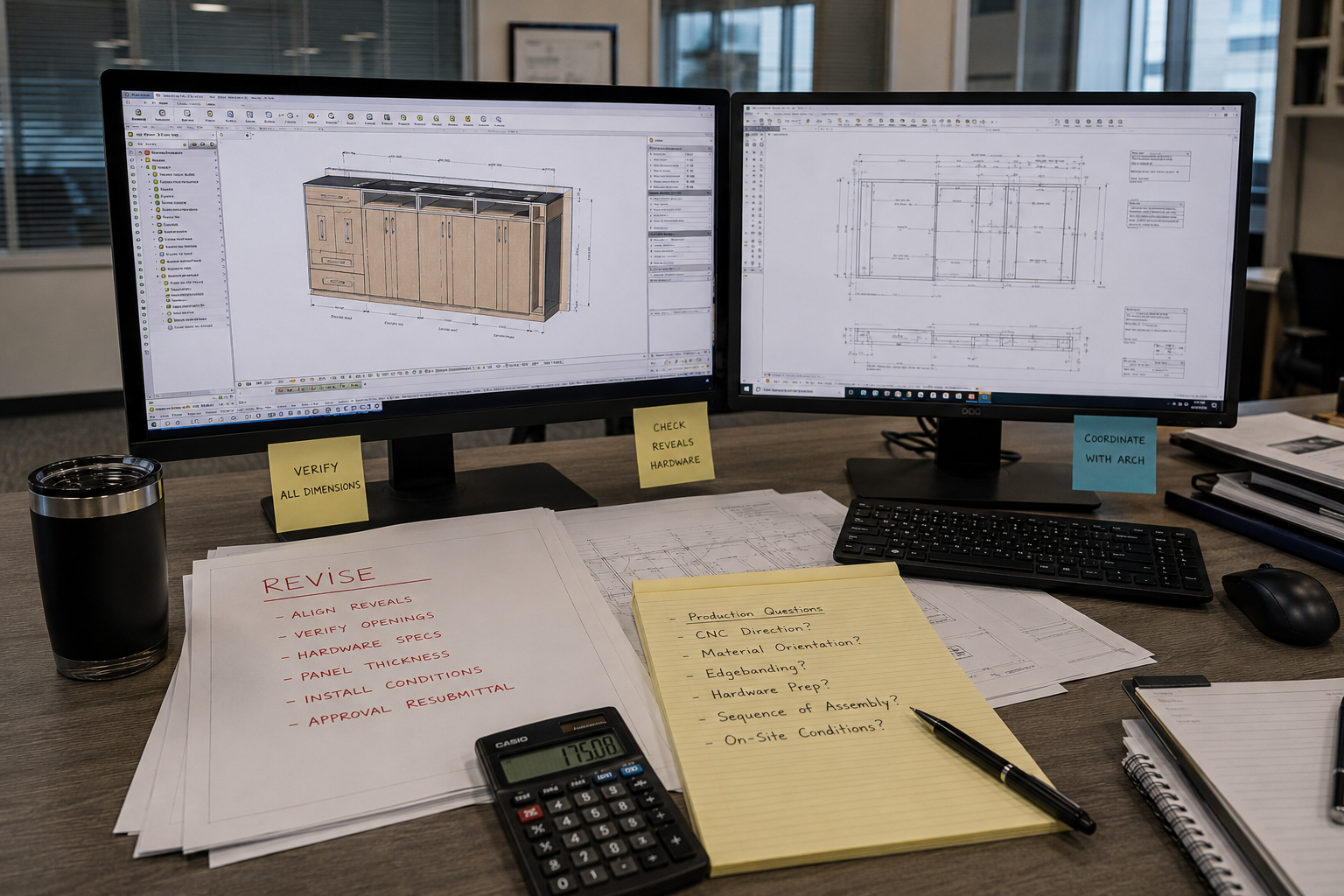
The Most Expensive Mistakes in Millwork Engineering Don’t Happen on Paper
Clean drawings do not always mean production-ready engineering.
A drawing can look clean.
Dimensions can be correct.
The title block can be organized.
The renderings can look impressive.
And the project can still become a production disaster.
Because great millwork engineering is not about simply drawing cabinets.
It’s about understanding manufacturing.
A Cabinet Can Work in Software and Still Fail in Production
A detail that looks correct on a submittal may still create:
- assembly issues
- machining conflicts
- installation complications
- sequencing problems
- unnecessary labor
- field failures
The true cost of poor engineering rarely appears immediately.
It shows up later:
- when production stops to ask questions
- when installers cannot make conditions work
- when parts require remakes
- when CNC output requires manual correction
- when revisions multiply
- when schedules begin slipping
Great Engineering Supports Manufacturing
The best engineering departments are not simply drafting departments.
They are manufacturing support systems.
They understand:
- material behavior
- hardware application
- CNC limitations
- production flow
- installation realities
- scalability
- revision control
- constructability
Good engineering produces drawings.
Great engineering reduces friction throughout the entire manufacturing process.
Why This Matters
In commercial millwork and custom manufacturing, engineering quality directly affects:
- labor hours
- approval speed
- production efficiency
- installation success
- profitability
At Saline Design Group, our focus is not simply creating drawings.
Our focus is developing production-oriented engineering that supports manufacturing, scalability, and real-world execution from submittal through CNC output.