
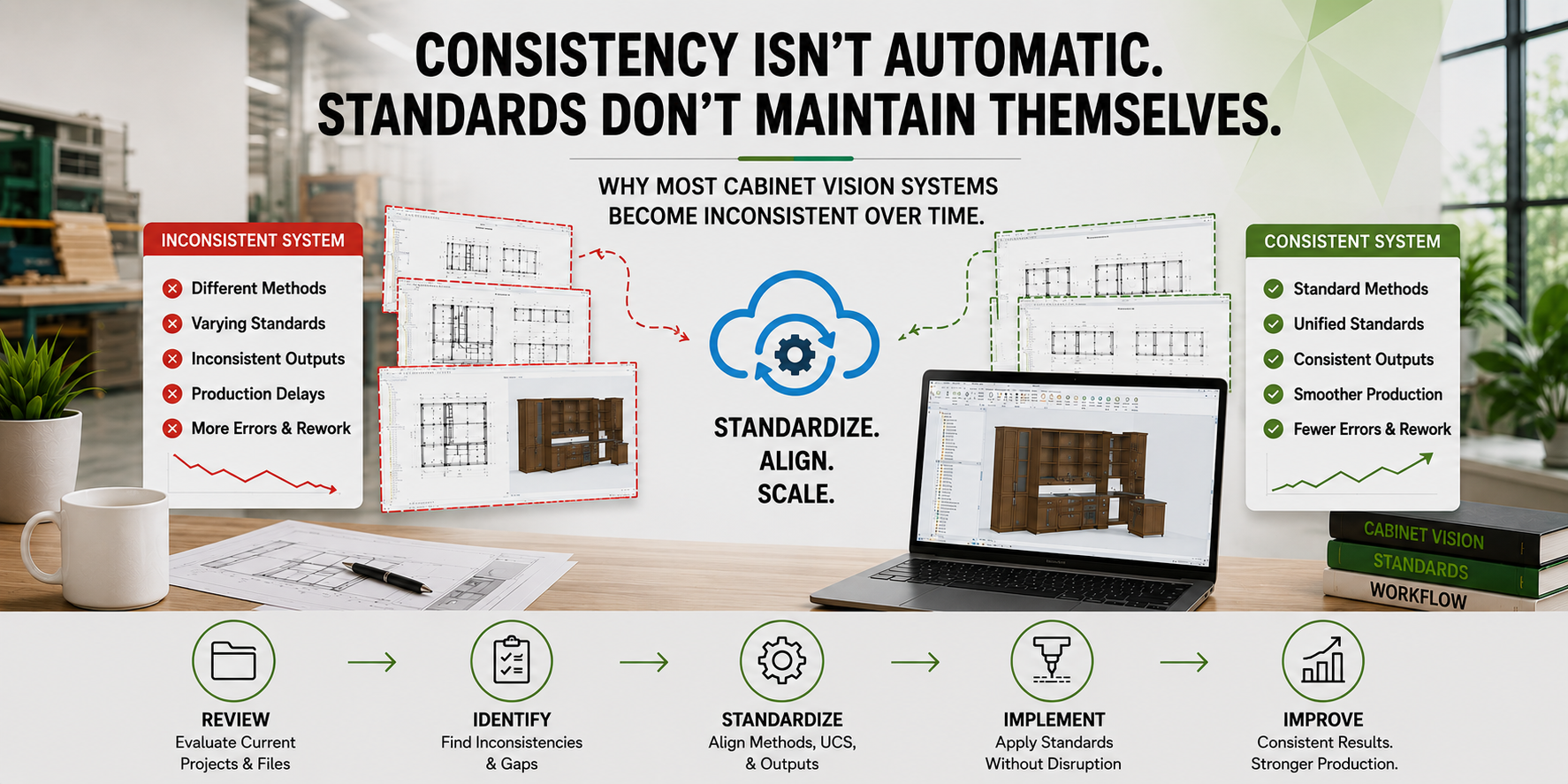
Why Most Cabinet Vision Systems Become Inconsistent Over Time
For many millwork shops, Cabinet Vision starts as a powerful system that improves drafting speed, accuracy, and CNC output. But over time, many shops begin to notice something different—projects start looking inconsistent, outputs vary, and workflows become harder to manage.
This isn’t a software problem.
It’s a systems problem.
The Real Cause: Engineers Come and Go
One of the biggest factors behind inconsistency is turnover.
As engineers, programmers, or drafters move in and out of a company, each person brings their own approach to:
- Construction methods
- Cabinet setup
- Layering and labeling
- Machining strategies
Without a locked standard in place, each new person makes adjustments based on their own experience.
Over time, those changes stack.
Small Changes Turn Into Big Problems
At first, inconsistencies seem minor:
- Slightly different cabinet builds
- Different naming conventions
- Alternate machining approaches
But across multiple projects, those small changes create:
- Confusion in production
- Slower CNC setup
- Increased errors and rework
- More time spent reviewing drawings
Eventually, no two projects look the same—even if they should.
Lack of a Standard Foundation
Most shops don’t intentionally create inconsistency. It happens because there is no clearly defined and enforced foundation within Cabinet Vision.
This includes:
- Construction methods that are not standardized
- User Created Standards (UCS) that vary by user
- Reports and outputs that aren’t aligned
- CNC strategies that change depending on who programmed the job
Without a consistent baseline, the system becomes dependent on the individual—not the process.
Why This Becomes a Production Issue
Inconsistency in Cabinet Vision doesn’t stay in engineering—it shows up on the floor.
Production teams begin to see:
- Unexpected part sizes
- Different machining patterns
- Missing or inconsistent labeling
- Extra time spent verifying parts
What started as a drafting inconsistency turns into a production bottleneck.
The Fix Isn’t Starting Over
A common reaction is to think:
“We need to rebuild everything from scratch.”
In most cases, that’s not necessary—and it can actually slow production down further.
A better approach is to:
- Review existing project files
- Identify patterns and inconsistencies
- Standardize construction methods gradually
- Align outputs without disrupting active work
This allows the system to improve while production continues.
Start With What You Already Have
You don’t need a perfect system to begin improving consistency.
A single recent project can reveal:
- How cabinets are currently being built
- What standards exist (even if informal)
- Where inconsistencies are occurring
From there, improvements can be made step by step.
Final Thoughts
Cabinet Vision is only as strong as the standards behind it.
Without consistency, even the best software becomes difficult to manage and scale.
The goal isn’t to rebuild everything—it’s to create a stable foundation that allows anyone to plug into the system and produce consistent, predictable results.
At Saline Design Group, we help millwork shops review, align, and strengthen their Cabinet Vision workflows—without disrupting production.